Postpartum Pelvic Girdle Pain: What Your Body Is Trying to
Tell You
By Dr. Anna Hoang, DC — CHIRO HAUS | Katy, TX | March 2026
You made it through pregnancy. You brought a new life into the world. And now, weeks or months later, you’re still hurting in ways nobody warned you about — a deep ache in your hips, a sharp catch near your tailbone when you roll over in bed, or pain right at the front of your pelvis that makes walking feel like a chore. If any of that sounds familiar, you may be dealing with postpartum pelvic girdle pain. It is incredibly common, often undertreated, and — here is the part we most want you to hear — very treatable. This post will walk you through what pelvic girdle pain actually is, what chiropractic care does for it, and when to pay closer attention to what your body is signaling. You deserve to feel good in your body again, and we’d love to help you get there.
► Dealing with pelvic pain after baby? Book a free discovery visit at CHIRO HAUS — www.thechirohaus.com
What Is Postpartum Pelvic Girdle Pain?
Pelvic girdle pain (PGP) is a broad term that describes pain in and around the pelvic ring — the bony structure that connects your spine to your legs. It typically involves one or more of three joints:
• The sacroiliac (SI) joints — where your sacrum meets your ilium on either side of your lower back. Pain here is often felt as a deep, one-sided ache in the buttock or hip, sometimes radiating down the back of the thigh.
• The pubic symphysis — the cartilaginous joint at the very front of the pelvis. Pain here is often described as a sharp, stabbing sensation at the pubic bone, inner thighs, or groin, and is frequently worse with walking, stairs, or spreading the legs.
• The coccyx (tailbone) — less common, but coccyx pain after delivery — particularly after prolonged pushing or instrumental delivery — can make sitting and transitioning from sitting to standing genuinely painful.
It is also possible — and quite common — to have pain at more than one of these locations simultaneously. The pelvis functions as an integrated ring, and dysfunction at one joint frequently affects the others. Pelvic girdle pain is not the same as pelvic floor dysfunction, though the two often occur together. Pelvic floor issues involve the muscles inside the pelvis. PGP involves the joints and connective tissues of the pelvic ring. At CHIRO HAUS, we assess both.
Why Does It Happen After Having a Baby?
Pregnancy and delivery place extraordinary demands on the pelvic ring. Several factors contribute to why pain can persist — or even begin — in the postpartum period: Hormonal changes and relaxin During pregnancy, your body produces a hormone called relaxin that loosens the ligaments of the pelvis to allow for the changes of pregnancy and the passage of birth. Relaxin levels begin to decline after delivery but can remain elevated for months, particularly in breastfeeding mothers. This means the joints of the pelvis may remain more lax and vulnerable to strain well beyond the birth itself. Postural and load shifts The significant postural changes of pregnancy — increased lumbar lordosis, anterior pelvic tilt, widened gait — do not automatically resolve after delivery. Carrying, feeding, lifting, and baby-wearing in the weeks and months postpartum often perpetuate these patterns, keeping the pelvis in positions that stress already-sensitized joints. Core and pelvic floor deconditioning The muscles that stabilize the pelvis — the deep core, the glutes, and the pelvic floor — are all affected by pregnancy and delivery. When these stabilizers are not functioning optimally, the joints of the pelvis have to absorb more load than they are designed for. Over time, that excess load becomes pain. Delivery trauma Both vaginal and cesarean deliveries can contribute to pelvic pain in different ways. Perineal tearing, episiotomy, prolonged pushing, or instrumental delivery can directly stress the pelvic floor and pelvic joints. Cesarean delivery involves significant abdominal tissue disruption that can alter load transfer through the pelvis for months afterward.
What Does Chiropractic Actually Do for Pelvic Girdle Pain?
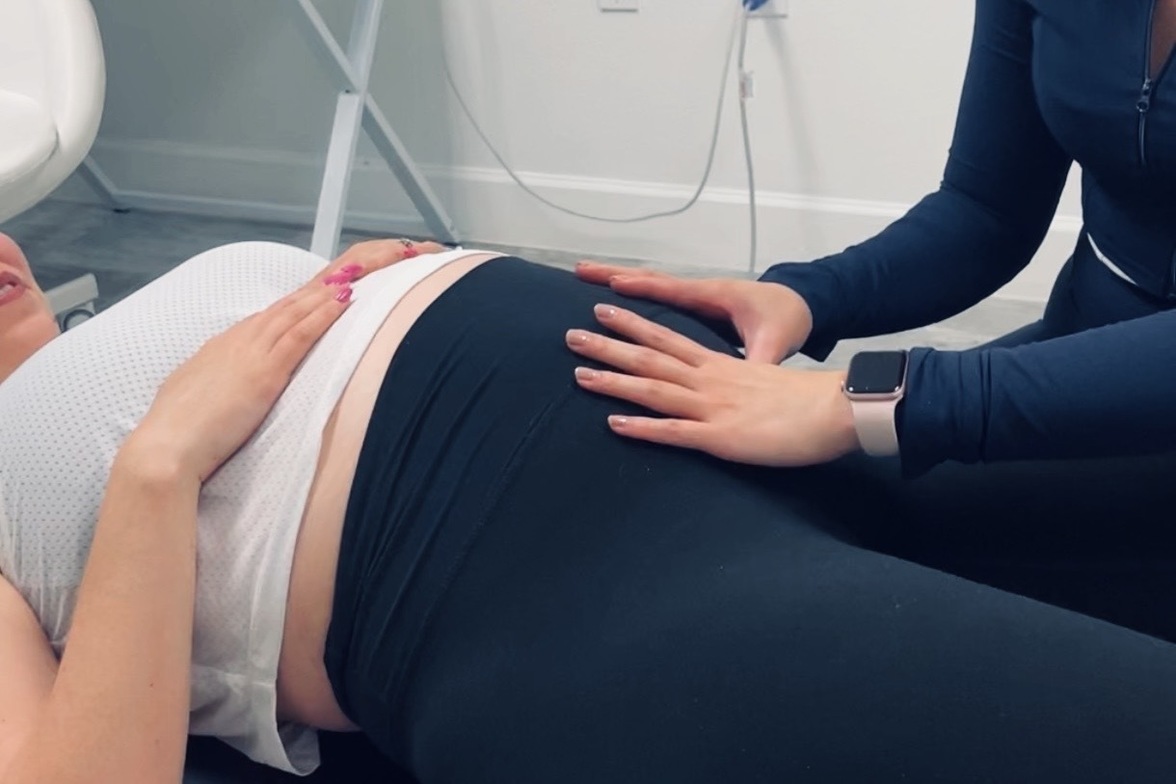
This is one of the questions we love answering, because the honest answer is: quite a lot — when it is done well and within a comprehensive approach. At CHIRO HAUS, chiropractic care for postpartum PGP is not just about adjusting the SI joint and sending you on your way. Here is what a thorough approach actually looks like: Movement assessment first Every patient at CHIRO HAUS begins with a full movement screen (SFMA). This helps us understand not just where you hurt, but why — and which movement dysfunctions are contributing to your pain. Pelvic pain that comes from a hip mobility restriction is treated differently than pelvic pain that comes from a core stability deficit or a lumbar joint restriction. The screen tells us which one we are actually dealing with. Manual therapy and chiropractic adjustments Specific, gentle adjustments to the SI joints, lumbar spine, and pelvis can restore normal joint motion, reduce local inflammation, and interrupt the pain-protective muscle guarding patterns that build up around a painful joint. In the postpartum period, we are especially thoughtful about force and direction — adjustments are modified based on your tissue state and recovery stage. Soft tissue work The muscles around a painful pelvic joint — the piriformis, gluteus medius, hip flexors, and thoracolumbar fascia — often become hypertonic and restricted in response to joint irritation. Releasing these tissues reduces the compressive load on the joint and allows the adjustment to hold longer. Corrective exercise and home programming Restoring the stabilizing function of the glutes, deep core, and pelvic floor is what makes the change last. We build a structured corrective exercise program through TrueCoach that progresses with you between visits — so you are never just waiting for your next appointment to feel better. Most of our postpartum PGP patients begin to notice meaningful improvement within the first 3–4 visits. Full resolution — including return to exercise — typically takes 6–12 weeks of consistent care and home programming, depending on severity and how long symptoms have been present.
When to Pay Closer Attention: Red Flags to Know
Postpartum pelvic pain is common, and in most cases it responds beautifully to conservative care. However, there are some symptoms that warrant closer evaluation and, in some cases, prompt medical attention. Please do not ignore these: Seek prompt medical evaluation if you experience any of the following:
• Numbness, tingling, or weakness in one or both legs
• Loss of bladder or bowel control (beyond typical postpartum leakage)
• Severe, worsening pain that is not responsive to rest or position changes
• Pain accompanied by fever, chills, or signs of infection
• A feeling of significant pelvic pressure or prolapse (a sensation of something falling out)
• Pain following a fall or direct trauma to the pelvis
These symptoms do not necessarily mean something is seriously wrong, but they do mean your care team needs more information before proceeding with manual therapy. At CHIRO HAUS, we screen for these at every initial visit and will always refer appropriately when something is outside our scope.
You Do Not Have to Just “Wait It Out”
One of the things that saddens us most is hearing from moms who were told their pelvic pain was normal and that it would go away on its own — and then coming to see us a year or two later, still hurting, having lost so much in the meantime. Time with their baby, workouts they loved, sleep, comfort. Pelvic girdle pain is common. That does not make it normal, and it does not mean you should accept it. Whether you are 6 weeks postpartum or 2 years out and still dealing with hip, tailbone, or pubic pain, there is almost always something we can do to help. The sooner we start, the faster and more completely things tend to resolve — but it is truly never too late. If you are in Katy, Cinco Ranch, Richmond, or anywhere in the greater Houston area, we would love to be part of your recovery. Our team at CHIRO HAUS sees postpartum moms every single week, and helping you feel like yourself again is something we genuinely love to do.
Quick Questions, Honest Answers
Q: How long does postpartum pelvic girdle pain last?
A: Without treatment, symptoms can persist for months to years in a significant number of cases. With targeted care — manual therapy plus corrective exercise — most women see meaningful improvement within 4–8 weeks. Starting sooner leads to faster resolution.
Q: Can I exercise if I have pelvic girdle pain?
A: Yes, with guidance. Complete rest is not the answer and often makes things worse. Low-impact, core-supportive movement is generally encouraged. We help you identify what is safe at your current stage and build from there.
Q: Does breastfeeding make pelvic pain worse?
A: It can, indirectly. Breastfeeding prolongs relaxin elevation, which can maintain joint laxity. It also changes posture (many moms develop a forward-head, rounded-shoulder position from feeding) and affects sleep and recovery. None of this means you should stop breastfeeding — it just means we factor it into your care plan.
Q: Is pelvic girdle pain the same as sciatica?
A: Not exactly, though they can feel similar. True sciatica involves compression or irritation of the sciatic nerve, typically producing pain, numbness, or tingling that radiates down the leg below the knee. SI joint pain can refer into the buttock and upper thigh but usually does not travel below the knee. A proper assessment helps distinguish between them — and the treatment approaches differ.
Your Body Did Something Incredible. Now Let’s Help It Recover.
Carrying and delivering a baby is one of the most demanding things a human body can do. The fact that you are still feeling the effects is not a sign of weakness — it is a sign that your body is asking for the right support to finish the job. At CHIRO HAUS, we are here to give you exactly that. A thorough assessment, a clear plan, and 1-on-1 care with a doctor who is genuinely invested in your recovery. Book your free discovery visit today. Let’s figure out what is going on and build a path forward — together.
► Book your free discovery visit at CHIRO HAUS — www.thechirohaus.com
CHIRO HAUS is a movement-based, rehab-oriented chiropractic clinic in Katy, TX, serving families in Katy, Cinco Ranch, Richmond, and the greater Houston area. All sessions are 1-on-1 with your doctor. Dr. Jonathan Chapa and Dr. Anna Hoang are co-founders and co-owners of CHIRO HAUS.
Anna Hoang
Chiropractor | BirthFit Coach | Webster Technique Certified | Graston Technique Certified | SFMA/FMS Provider
Contact Me.jpg)