You made it through pregnancy and delivery. You're doing the most important, most exhausting, most beautiful work of your life. And somewhere in the middle of all of that — you're also dealing with pelvic pain that nobody seems to want to talk about directly.
Maybe it's a pressure or heaviness low in your pelvis. Maybe sitting for more than a few minutes is genuinely uncomfortable. Maybe intimacy has become painful and you don't know how to bring it up — or whether it's even something that can be fixed. Maybe you've been told it's just part of recovery and to give it time.
Here's what I want you to hear: postpartum pelvic pain is incredibly common, it is not something you simply have to accept, and there is almost always something meaningful we can do about it. This post is here to help you understand what's happening, distinguish what's normal from what deserves attention, and know what real, effective care looks like.
You deserve to feel like yourself again.
Postpartum pelvic pain and pelvic floor dysfunction can show up in many different ways. Not every woman experiences the same combination of symptoms — but here are the ones we hear most often at CHIRO HAUS:
If you recognized yourself in several of those — you are not being dramatic, and you are not alone. Let's talk about why this happens.
Postpartum pelvic pain is rarely caused by a single thing. It's usually the result of several overlapping factors — which is exactly why a thorough assessment matters more than a one-size-fits-all approach.
Relaxin — the hormone that loosens the ligaments of the pelvis to prepare for birth — doesn't immediately disappear after delivery. It can remain elevated for months postpartum, particularly in breastfeeding moms. During this period, the joints of the pelvic ring (the sacroiliac joints and the pubic symphysis) remain more lax than normal and more vulnerable to strain, compression, and irritation. This is one of the most underrecognized reasons why postpartum pelvic pain can persist well beyond the early weeks.
The pelvic floor — a hammock of muscles, ligaments, and fascia at the base of the pelvis — supports the uterus, bladder, and bowel throughout pregnancy and plays a central role in delivery. By the time your baby arrives, these muscles have been under sustained load for nine months, stretched beyond their normal capacity, and often strained or torn during the birthing process itself. Whether you pushed for hours, experienced perineal tearing, or had a cesarean that disrupted the abdominal-pelvic connection, your pelvic floor bears the evidence of delivery.
When the pelvic floor is weakened, overactive, or poorly coordinated after birth, the rest of the body compensates. Hip muscles take on more load. The lower back stiffens to protect an unstable pelvis. Breathing patterns shift to avoid engaging a core that feels unreliable. Over time, these compensatory patterns create their own layers of pain and dysfunction — and the original source becomes harder to identify without a proper movement assessment.
Scar tissue from delivery — whether at the perineum or at the abdominal wall following a C-section — can restrict mobility, alter fascial tension through the pelvis, and contribute to pain with sitting, intimacy, or movement. Scar tissue mobilization is a key component of comprehensive postpartum pelvic care and is something we address directly at CHIRO HAUS.
One of the most common things we hear from new moms is: "I wasn't sure if what I was feeling was just normal recovery." It's a fair question — and the answer matters, because the line between expected recovery and something that needs care isn't always obvious. Here's how we think about it:
The general principle: mild, improving symptoms in the first 4–6 weeks are an expected part of healing. Symptoms that are persistent, worsening, or affecting your daily life beyond that window are worth addressing — not waiting out.
Most postpartum pelvic pain is musculoskeletal and responds beautifully to the right care. But some symptoms need prompt evaluation. Please take these seriously:
At CHIRO HAUS, we screen for these at every initial postpartum visit. If something is outside our scope, we will refer you directly to the right provider — we work collaboratively with pelvic floor physical therapists and OB providers throughout the Katy and Houston area.
Our approach to postpartum pelvic pain is movement-based and rehabilitation-focused — which means we're not just adjusting the pelvis and sending you home. We're identifying the root cause, restoring function, and giving you the tools to maintain that progress between visits and long after care ends.
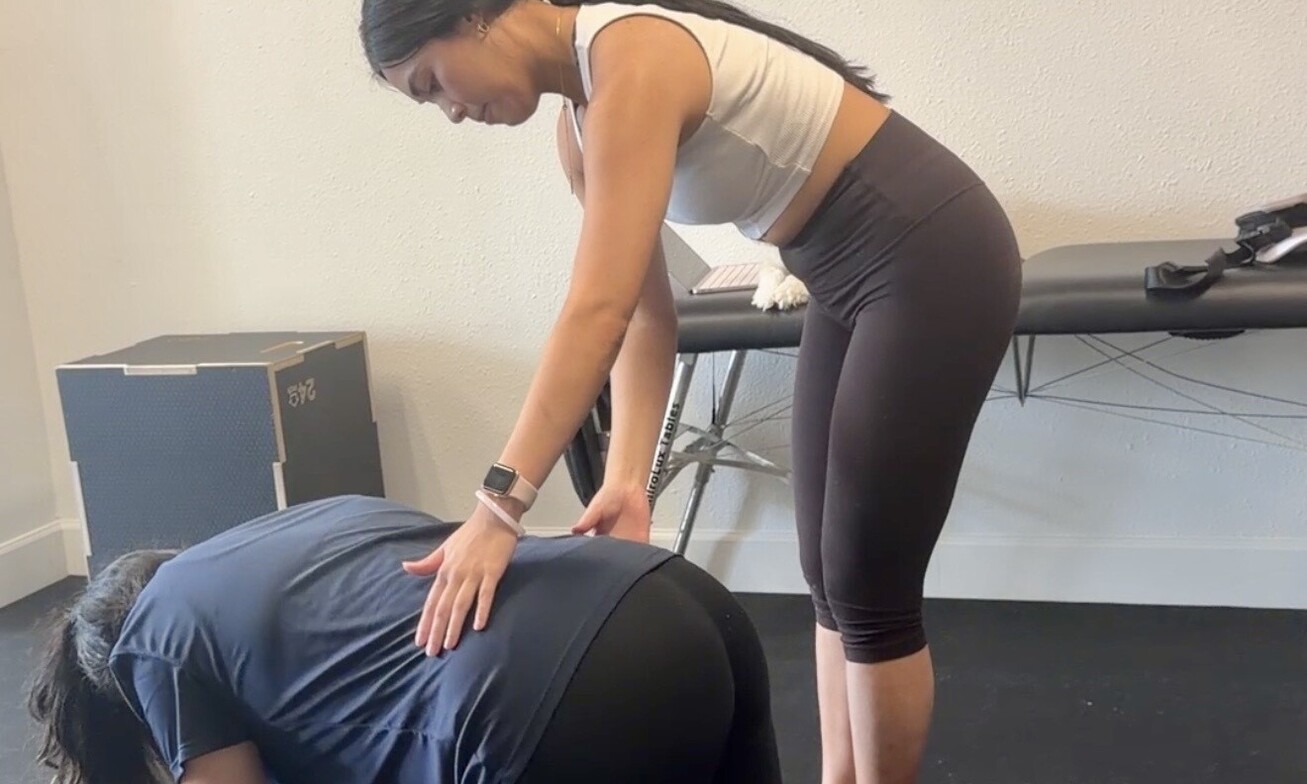
Every patient at CHIRO HAUS begins with a full Selective Functional Movement Assessment (SFMA) — a systematic evaluation of how your whole body moves. This allows us to see not just where the pelvic pain is, but which movement patterns are breaking down and what's driving those breakdowns. Pelvic pain from a rotated sacrum requires different treatment than pelvic pain from an overactive pelvic floor or a restricted hip. The SFMA tells us which one we're working with.
Dr. Anna is Webster Technique certified — a specific chiropractic analysis and adjustment of the sacrum, SI joints, and supporting ligaments. While the Webster Technique is widely known for its prenatal applications, it is equally powerful in the postpartum period for restoring pelvic symmetry and reducing the joint-level dysfunction that underlies so much postpartum pelvic pain. Balanced pelvic mechanics are the foundation everything else is built on.
As a BirthFit Coach, Dr. Anna understands that the pelvic floor is not an isolated structure — it is part of a system that includes the diaphragm, the deep abdominal wall, the glutes, and the hips. Our rehab approach focuses on restoring the coordination and strength of this entire system, not just cuing a mom to "do her Kegels." In fact, for many postpartum moms with pelvic pain, the pelvic floor is hypertonic — too tight, not too weak — and the last thing that helps is more squeezing. The assessment tells us which direction your pelvic floor needs to go.
Between visits, your recovery continues at home through a personalized program delivered via TrueCoach. Every exercise is specific to what your screen revealed, comes with video demonstration, and is designed to fit into the reality of new mom life — which means 10–15 minutes, not an hour, and movements you can do on your living room floor while your baby naps.
We see a wide range of postpartum moms at CHIRO HAUS — and the thing they have in common is not a specific diagnosis, but a feeling of being stuck between "this isn't right" and "I don't know what to do about it." Here are some of the moms who find their way to us:
If any of those sound like you — regardless of how far out from delivery you are — we would love to meet you.
At CHIRO HAUS, every new patient starts with a free discovery visit — a dedicated 1-on-1 conversation with Dr. Anna before any assessment or treatment begins. Here's how the first two visits unfold:
Your baby is always welcome at both visits. If you need to nurse, feed, or tend to your little one, please do — we'll work right around you.
No referral needed. You can book directly online. That said, we love collaborating with OBs, midwives, and pelvic floor PTs — and if your care involves other providers, we're always happy to communicate with your team. Many of our patients come to us as a complement to what their OB is already doing, not as a replacement.
Pelvic floor PT and chiropractic care are complementary — not competing. A pelvic floor PT works primarily with the internal muscular system, while we work with the skeletal alignment, joint mobility, and movement patterns that influence how the pelvic floor functions. Many of our postpartum patients see both and find that the two approaches together produce better results than either alone. If we feel a pelvic floor PT referral would benefit you, we'll say so directly and can help connect you with providers we trust in the Katy and Houston area.
Never. We see moms at every stage — 6 weeks, 6 months, 2 years postpartum. The body responds remarkably well to the right care regardless of how long the issue has been present. The approach may look slightly different for a mom who is 2 years out versus 2 months, but the process is the same. You deserve to feel well in your body at every stage of motherhood.
Absolutely. Prenatal chiropractic care is something we offer throughout all three trimesters and it's an excellent time to address any pelvic pain or instability before the demands of delivery. If you're pregnant again and carrying unresolved pelvic dysfunction from your first delivery, getting ahead of it now can make a meaningful difference in how you feel through this pregnancy — and how you recover afterward. You can learn more about our prenatal care approach on our prenatal services page.
Postpartum pelvic pain is common — but it is not something you simply have to live with. Whether you're weeks or years out from delivery, there is almost always something meaningful we can do to help you feel better, move better, and get back to the life you want to be living.
We serve moms in Katy, Cinco Ranch, Richmond, and the greater Houston area. Your first visit is free — come in, let's talk, and let's build a plan together.
Book Your Free Discovery Visit →Anna Hoang
Chiropractor | BirthFit Coach | Webster Technique Certified | Graston Technique Certified | SFMA/FMS Provider
Contact Me.jpg)