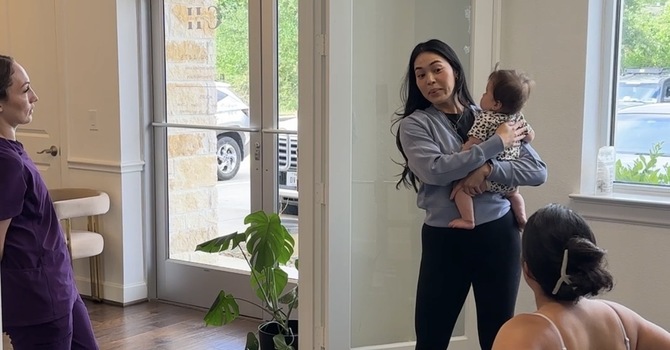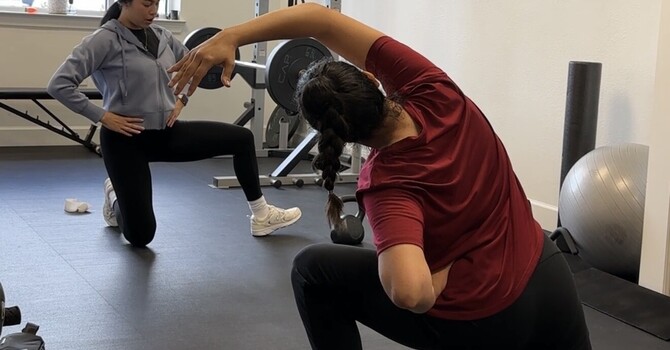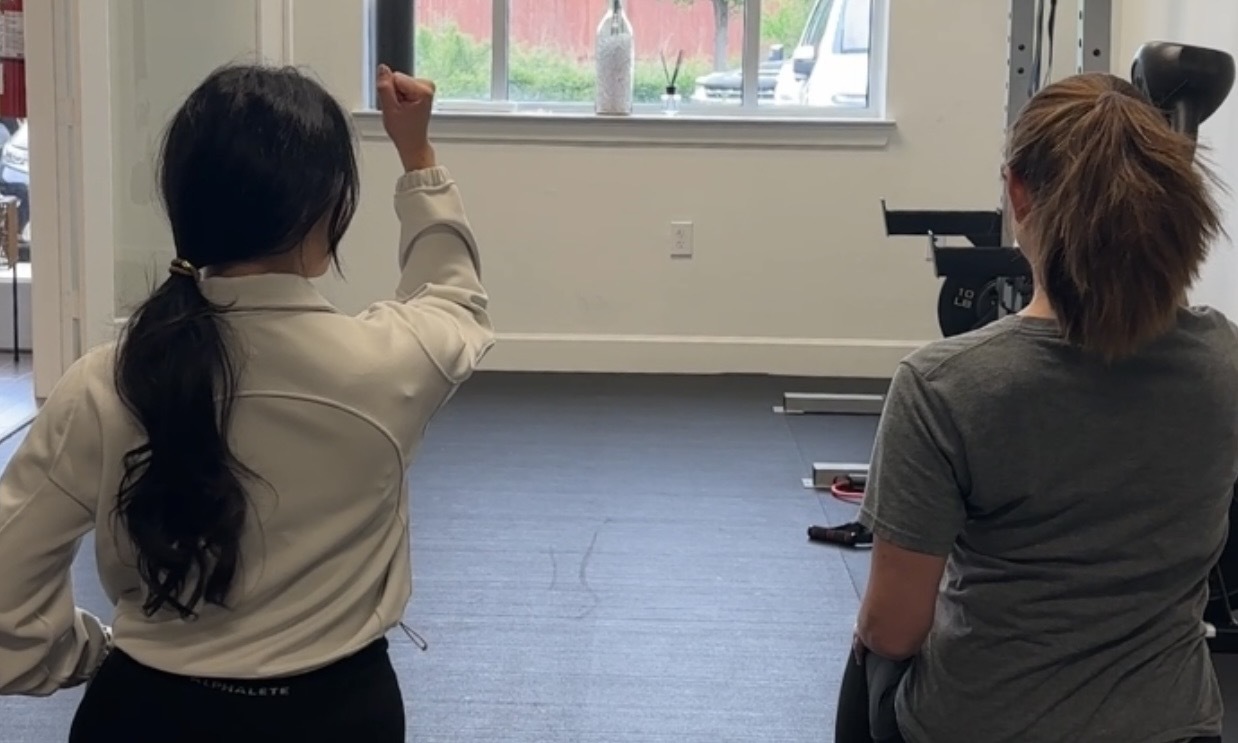
You crossed the finish line at your last HYROX. Then life happened — in the best possible way. Now you’re cleared by your OB, your running shoes are calling, and you’re wondering: how do I actually get back to training without wrecking my body in the process? The 6-week clearance is a starting line, not a green light for sleds and ski ergs. Here is what the research says, what we see clinically at CHIRO HAUS, and how to build back to HYROX performance the right way.
► Ready to get assessed before you train? Book a free discovery visit today.
Why HYROX Is a Unique Postpartum Challenge
HYROX is not just cardio. It combines eight functional movements — sled push, sled pull, burpee broad jumps, rowing, ski erg, wall balls, sandbag lunges, and farmers carries — all under sustained aerobic load. Every one of those movements places significant demand on the pelvic floor, the deep core, and the lumbar-pelvic-hip complex. After pregnancy and delivery, these systems are in a state of adaptation. The linea alba may be widened (diastasis recti), the pelvic floor is typically weakened or dyscoordinated, hormonal changes from relaxin persist well into the postpartum period, and lumbar stability patterns are often altered. Jumping back into high-load, high-volume training without addressing these factors is one of the most common reasons we see postpartum athletes develop chronic hip, low back, and pelvic pain. The goal is not to slow you down indefinitely. The goal is to give your body the foundation it needs so that when you do get back on the competition floor, you perform at your best — and stay there.
What the Research Says About Postpartum Return to Sport
The most widely referenced postpartum return-to-sport guidelines recommend a structured, phased approach based on tissue healing timelines rather than a fixed number of weeks. The general consensus:
• Low-load rehabilitation (breathing, pelvic floor activation, core reintegration) can begin within the first few weeks postpartum, depending on delivery type and individual recovery.
• Running and moderate-impact activity is generally not recommended before 12 weeks, and ideally only after a functional assessment has confirmed adequate pelvic floor and load-transfer capacity.
• High-load compound movements — the kind that define HYROX — should be reintroduced progressively after the above benchmarks are met and ideally under the guidance of a movement-informed clinician.
Every athlete is different. A vaginal delivery at 38 weeks with no complications carries a different recovery profile than a prolonged labor, instrumental delivery, or cesarean section. Timelines matter, but movement quality matters more.
The 4 Phases of Postpartum Return to HYROX
Phase 1: Restore (Weeks 1–6) Focus: Breathing mechanics, pelvic floor awareness, and gentle mobility. At this stage, the priority is restoring intra-abdominal pressure management and reconnecting with the deep stabilizing system. This is not passive rest — it is intentional, targeted movement.
• Diaphragmatic breathing drills
• Pelvic floor contractions and relaxation sequencing
• Gentle hip and thoracic mobility
• Walking, progressed incrementally
Phase 2: Rebuild (Weeks 6–12) Focus: Core stability, load introduction, and neuromuscular re-patterning. This phase begins to reintroduce movement patterns that mirror HYROX demands — hinge, squat, carry — but at low load and high attention to quality.
• Dead bugs, bird dogs, pallof press variations
• Goblet squats and Romanian deadlifts with moderate load
• Single-leg work: split squats, step-ups
• Low-impact conditioning: bike, rower at moderate intensity
Phase 3: Reload (Weeks 12–20+) Focus: Progressive loading, impact reintroduction, and movement capacity testing. This is where we begin reintroducing the specific demands of HYROX — including sled work, loaded carries, and eventually running — with systematic progression and ongoing monitoring.
• Return to running protocol (walk-run intervals, progressed over 4–6 weeks)
• Sled push and pull at sub-maximal load
• Sandbag carries with controlled breathing
• Ski erg and rowing at moderate intensity
Phase 4: Perform (20+ Weeks) Focus: Sport-specific training, race simulation, and performance optimization. Athletes who have completed Phases 1–3 with proper movement quality can now train with intent. Volume and intensity can be progressed toward competition-level demands. Importantly, this phase is not the end of attention to pelvic health and core function — it is an integration. The work you did in the earlier phases should be reflected in how you move under load, not abandoned once the weights get heavier.
Red Flags to Watch For During Postpartum Training
The following symptoms during or after training are not normal adaptations to exercise — they are signals that your system is being loaded beyond its current capacity. If you experience any of these, scale back and seek assessment:
• Urinary leakage with jumping, heavy lifting, or impact
• Pelvic pressure or heaviness during or after training
• Pelvic pain, pubic symphysis pain, or SI joint pain
• Lower back pain that persists or worsens with training
• Visible doming or coning at the midline during core exercises
These are not signs that you need to stop training permanently. They are signs that your current program is ahead of your tissue capacity, and that a movement assessment would help bridge the gap.
How CHIRO HAUS Approaches Postpartum Athletic Recovery
At CHIRO HAUS, every postpartum patient — whether you’re a first-time mom or a competitive HYROX athlete — starts with a full movement screen. We use the Selective Functional Movement Assessment (SFMA) to evaluate how you move globally before identifying where the breakdowns are occurring at the segmental level. This matters because pain in one place is rarely caused by a problem in that same place. A postpartum athlete with low back pain during sled pulls might have a hip mobility restriction, a pelvic floor coordination issue, or a core stability deficit — or all three. The movement screen tells us which one to address first. From there, we build a structured plan: manual therapy and adjustments where indicated, targeted corrective exercise in-session, and a TrueCoach program you can follow at home or in the gym between visits. The goal is not dependence on chiropractic care — it is giving you the tools to perform at your best without us.
Frequently Asked Questions
Q: How soon after birth can I start training for HYROX again?
A: There is no universal answer, but a reasonable target for returning to HYROX-specific training is 20–24 weeks postpartum, assuming a phased approach has been followed and a movement assessment confirms readiness. Some athletes may be ready earlier; others may need more time. The key is building the foundation first.
Q: Do I need to see a pelvic floor physical therapist before a chiropractor?
A: Not necessarily — though both can be valuable. A movement-based chiropractor with a postpartum focus, like at CHIRO HAUS, is trained to evaluate global movement dysfunction and identify when a referral to a pelvic floor PT is indicated. Many of our patients work with both simultaneously for the best outcomes.
Q: Can I do HYROX while breastfeeding?
A: Yes, with some considerations. Relaxin levels remain elevated during breastfeeding, which can affect joint laxity and load tolerance. Adequate hydration and caloric intake become especially important, and training intensity may need to be modulated based on sleep quality and overall recovery demands.
Q: What if I had a C-section?
A: C-section recovery requires specific attention to the healing of the abdominal scar and the fascial layers beneath it. Return-to-sport timelines are typically longer, and scar tissue mobilization is an important component of the rehabilitation process. We address this at CHIRO HAUS as part of a comprehensive postpartum evaluation.
Ready to Return to HYROX the Right Way?
If you’re in Katy, Cinco Ranch, Richmond, or the greater Houston area and you’re serious about returning to HYROX performance after having a baby, we’d love to help you build that bridge. A free discovery visit at CHIRO HAUS gives you 30 minutes with one of our doctors to talk through where you are, what your goals are, and whether our approach is the right fit for you. No pressure, no obligation — just clarity.
► Book your free discovery visit
CHIRO HAUS is a movement-based, rehab-oriented chiropractic clinic in Katy, TX. We specialize in helping active adults and athletes — including postpartum moms — move better, perform better, and feel better. All sessions are 1-on-1 with your doctor.
Anna Hoang
Chiropractor | BirthFit Coach | Webster Technique Certified | Graston Technique Certified | SFMA/FMS Provider
Contact Me